

Milwaukee 7Seventy7 Apartments
Challenge:
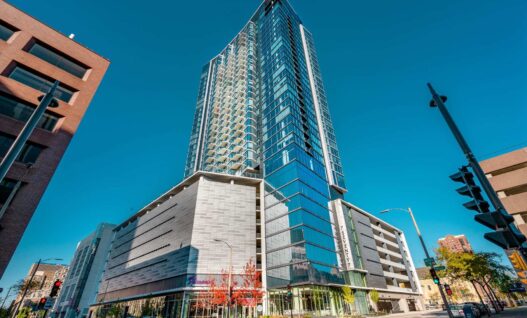
7Seventy7 Apartments in Milwaukee. Wisconsin, consists of a 33-story building with two levels of below-grade parking across the entire building footprint. Timely and cooperative teamwork among the owner/developer, geotechnical engineer, testing agency, structural engineer, construction manager, and pile-driving contractor resulted in an efficient, cost-effective, high-capacity driven-pile foundation on a constrained urban site with significantly variable subsurface conditions. Design objectives included utilizing the highest allowable pile loads reasonably installed from a drivability perspective, using readily available equipment. A pre-production test program was performed on 16-inch-diameter steel pipe piles, driven closed-ended and subsequently filled with concrete.
Method & Results:
The test program included dynamic monitoring of 10 piles during installation (5 indicator piles, 1 static load test pile, and 4 reaction piles), and of select piles during long-term restrike testing with a drop hammer. CAPWAP® analyses were performed on both end-of-initial-drive and beginning-of-restrike dynamic test records. The relaxation potential of piles terminating in dense fine-grained granular deposits was also evaluated by performing short-term restrike testing. The site exhibited significant soil set-up, even after relatively short wait times. Test program objectives included characterization of set-up profiles (cumulative shaft set-up as a function of embedment length). To evaluate tension resistance, the long-term shaft resistance magnitude and distribution was determined. An axial compression static load test, internally instrumented with vibrating-wire strain gages, was also performed.
Long-term capacity is the sum of two components: end-of-initial-drive (“EOID”) capacity, and soil set-up. The pile test program characterized both these components individually as functions of pile toe elevation. A design set-up profile was used to develop depth-variable driving criteria (minimum required EOID blow counts decreasing with embedment depth) for both 500- and 600-kip allowable load piles (safety factor = 2.0) driven from multiple subgrade elevations. Site variability was evidenced by the embedded lengths of production piles with a long-term ultimate capacity of 1,200 kips ranging from 52 to 150 feet, with an average of 66.5 feet.
The number of production piles damaged during driving was approximately 3%. Test program results were used to assist in assigning individual capacities to damaged piles, to piles which experienced practical refusal, and to the undamaged piles in the group. This was done in close coordination with the structural engineer who evaluated the actual required load for each group, and for each pile within the group, where damaged piles occurred. These combined efforts reduced the number of replacement piles which would have otherwise been required by 50%, saving both cost and time.

Project Details
Client: GEI Consultants
GRL Office: Illinois
GRL Services
- High Strain Dynamic Testing with APPLE Systems
- CAPWAP® Analyses
- Static Load Testing
- Soil/Pile Set-up Characterization
- Depth-Variable Driving Criteria