

Bridge Abutment and Boardwalk at TI’ awh ah dees Park
Challenge:
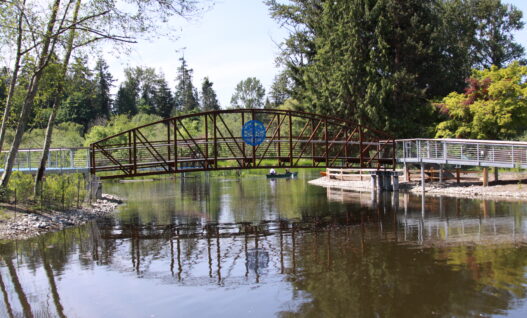
A small city in Washington known as Kenmore celebrated the renovations to a local park named TI’ Awh Ah Dees, previously Squire’s Landing. The goal of the renovations was to improve access to water while restoring vegetation for wildlife. New amenities to the community include pedestrian bridges and viewing decks, as well as pathways, elevated board walks, nature paths and a community gathering plaza. The city renamed the park with assistance from the Kenmore Heritage Society to honor many of the area’s indigenous residents, as well as the Coast Salish People who originally resided in the area. GRL Engineers provided pile driving monitoring for test piles on bridge abutments, and static load testing on boardwalks for the park.
Method:
GRLWEAP wave equation analyses were performed to determine if the proposed hammer would be sufficient to achieve the specified driving depths. The test piles were 12.75-inch diameter open-ended steel pipe piles. The proposed APE D8-42 diesel hammer system was evaluated for efficient blow count.
Three test piles were monitored with a Pile Driving Analyzer® (PDA) while impact driven with a diesel hammer. One pile in the south abutment of Bridge A, one pile in each abutment of Bridge B were tested. A restrike test was performed 4 days after initial driving to assess changes following soil set-up. CAPWAP® analysis of PDA data was performed to simulate static load testing.
Five of the park’s boardwalks were tested with static compression load tests. The reaction system used a 30-ton hydraulic jack. The pile top movement was monitored using 2 LVDTs and dial gage readings. The load was applied in 3 kips increments (5% the anticipated failure load per ASTM Procedure A) and typically held for 4 minutes at each load. Upon reaching the ultimate load of 60 kips, the load was held for 10 minutes. Unloading occurred over 4 decrements which were held for 4 minutes each.
Results:
The initial GRLWEAP analysis suggested the proposed APE D8-42 hammer would be able to install the test piles 60 and 80 feet with ultimate capacities of 175 and 185 kips. It was estimated that the required pile blow counts would be approximately 51 and 60 blows per foot, with a hammer ram stroke height of approximately 7.9 feet. Results shown in Figure 1.
During pile driving, the maximum hammer fuel setting was used resulting in averaged ram stroke heights at the end of initial driving of 7.8, 8.2, and 9.2 feet. The corresponding maximum energy transferred to the gage locations was 6.3, 9.0, and 9.7 kip-ft, respectively. The maximum dynamic pile top and bottom compression stresses reached values of 20.6 and 17.9 ksi, which was well below typical, maximum allowable stress limit for the pile type. CAPWAP® analyses of PDA data near the end of initial driving at a penetration of approximately 48 to 68 feet below grade, showed ultimate static capacities of 170 to 270 kips. Results can be viewed in Figure 2 for initial driving and Figure 3 for the restrike. The test pile that encountered re-strike showed an ultimate static capacity of 240 kips with a gain of approximately 70 kips in shaft friction.
The boardwalk test piles (6.625-inch diameter pin piles) were installed to final depths ranging from 31.0 to 36.0 feet below existing grade. The maximum applied load ranged from 48 to 60 kips. The maximum measured pile head movement ranged from approximately 0.481 to 2.896 inches. The calculated load vs displacement results for a typical pile can be viewed in Figure 4.


Project Details
Client: Strider Construction
GRL Office: Washington
GRL Services
- High Strain Dynamic Testing
- GRLWEAP Driveability Analysis
- CAPWAP® Analyses
- Static Load Testing
-

- Figure 1. Blow Count vs Stroke for Bridge Abutment
-

- Figure 2. CAPWAP Load vs Displacement Results for Bridge Abutment
-
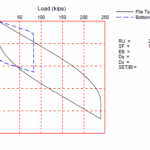
- Figure 3. CAPWAP Load vs Displacement Restrike Results for Bridge Abutment
-

- Figure 4. Static Load Test: Load vs Displacement Results for Boardwalk 2