

Central 70 Highway Project
Challenge:
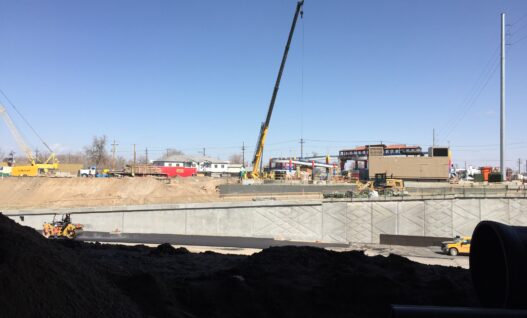
The Central 70 Project is a $1.2 billion endeavor to improve the widely used highway in Colorado. The project was started in 2018 to update the aged highway with 10 miles of reconstructed roads, add a new express lane in each direction, update the viaduct, lower the interstate, and construct a 4-acre park over part of the lowered interstate. The project’s contractor, Kiewit contracted GRL Engineers in 2020 to assess drilled caisson integrity with non-destructive testing methods for the BNSF Bridge Block and UPRR & Service Road over I-70 and bridges. The testing scope included a combination of Thermal Integrity Profiling (TIP), and Crosshole Sonic Logging (CSL). Over a duration of 2 years of testing, 50 plus drilled caissons have been tested by GRL Engineers.
Method:
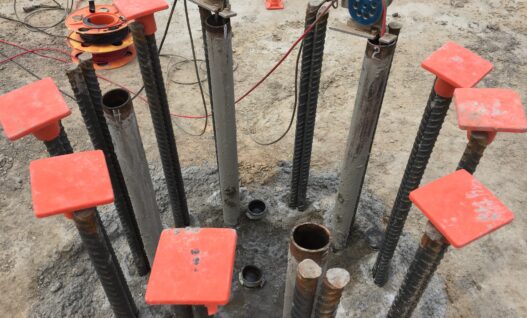
Working with Kiewit to meet UPRR, BNSF and CDOT specifications, GRL Engineers performed testing on the concrete integrity of many caissons. Thermal Wires were instrumented along the longitudinal bars of reinforcing cages to collect thermal data. The wires were attached TAP data loggers that collected and remotely transmitted stored data to the cloud in real-time. This allowed Kiewit and GRL to discuss potential anomalies in as little as 24 to 48 hours after concrete placement. CSL testing was performed on the caissons after a waiting period (i.e., typically after 48 to 72 hours). The CSL test method uses probes which were lowered into steel access tubes running the length of the caisson. The probes were pulled simultaneously while signals were collected between transmitter and receiver. This data was analyzed to determine the concrete consistency between the tubes.
Results:
During concrete curing, hydrating cement generates heat, increasing the temperature in the caisson. The individual TAP units automatically record the measured temperature at each sensor location along the length of the wire, at 15-minute intervals, generating a profile of temperature versus depth at each time increment. Figure 1 displays TIP test results from a 42-inch nominal diameter caisson. The crosshole sonic logging results, consisting of waterfall diagrams and corresponding plots of signal first arrival time and signal strength (energy), are provided in CSL testing results are represented in Figure 2. The combination of these testing methods provided a robust representation of the caisson integrity.





Project Details
Client: Kiewit Infrastructure Co.
GRL Office: Colorado
GRL Services
- Crosshole Sonic Logging
- Thermal Integrity Profiling
-

- Figure 1. Sample Thermal Integrity Profiling Results
-

- Figure 2. Sample Crosshole Sonic Logging Results