

Cross-Border Testing on the Gordie Howe Bridge
Challenge:
GRL Engineers provided deep foundation testing services for the landmark Gordie Howe International Bridge for both the United States and Canadian sides. The bridge has the longest main span of any cable-stayed bridge in North America, spanning 2,800 ft. GRL provided deep foundation recommendations and testing services starting in 2019. GRL services were provided for both the driven pile foundations and drilled shafts constructed for bridge support. The requirements for debris thickness at the base of the drilled shafts were very strict and required advanced drilled shaft bottom cleanliness testing.
Method:
The specification for drilled shaft base cleanliness required that less than 0.25 inches of debris and a “flat line” behavior of the curves (indicative of encountering hard rock). The Shaft Quantitative Inspection Device (SQUID) was utilized to measure debris thickness using three penetrometers which collected displacement measurements. The SQUID was deployed using crane lines with weights, as opposed to using the drill rig Kelly bar. The specifications also required eleven locations of the shaft base to be tested as is indicated in Figure 1, for shafts having a 9.8 ft diameter. On the Canadian side of the project, the rock encountered in the shafts was extremely hard. The rock encountered on the U.S. side was found to be relatively soft.
Before pile installation began on the approach bridges to the main span, GRL performed GRLWEAP Wave Equation analysis for the project. The purpose of the wave equation analyses was to evaluate the feasibility of various driving systems to install precast prestressed concrete piles and H-piles to hardpan soils efficiently and without damage.
During pile installation, GRL performed Pile Driving Analyzer (PDA) tests and CAPWAP analyses to monitor pile installation and assess the nominal driving resistance during initial driving and restrike. The piles used for most of the approach bridges were 16-inch precast prestressed concrete piles which required splicing. Some of the structures utilized 14×102 steel H-piles.
Results:
The SQUID tests on the US side of the bridge indicated sediment/debris thickness above specification in several locations of the shafts. The tooling and cleanout methods were optimized to yield acceptable debris thicknesses for all shafts. The SQUID tests on the Canadian side of the bridge were complicated by the undulating surface of the very high strength rock at the bottom of the shaft. Often multiple tests were necessary as some tests resulted in acceptable data from only a single probe.
The concrete piles were required to obtain an ultimate capacity of 700 kips. At the end of initial driving of concrete piles, mobilized pile capacities computed from CAPWAP analysis ranged from 710 to 840 kips. The steel piles were required to obtain an ultimate capacity of 600 kips. At the end of initial driving mobilized pile capacities computed from CAPWAP analysis ranged from 780 to 1070 kips.


-

- Figure 1. Sample Force vs Displacement Results from Canada Side SQUID Test
-

- Figure 2. Sample Force vs Displacement Results from US Side SQUID Test
-

- Figure 3. Sample Abutment Load vs Displacement
-
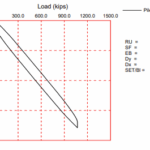
- Figure 4. Sample Cut Wall Load vs Displacement