

Dynamic Load Testing of Micropiles
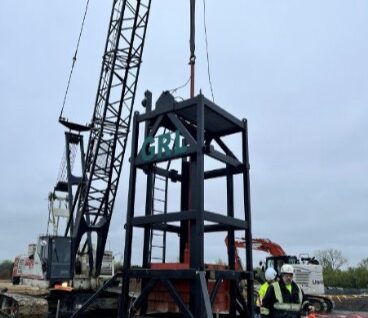
Micropiles were first used in Italy for retrofitting existing structures and enhancing the load bearing capacity of their foundations. Micropiles lend themselves to installation in constrained spaces, often with low headroom and are utilized in locations with very soft overburden soils. Compression static load testing, although a commonly used and highly accepted method, is not easily accomplished in these conditions. As such tension static load testing is more commonly performed to assess the load bearing capacity of these piles. Since the early 2000s GRL Engineers have utilized APPLE drop weight systems to perform dynamic load tests on micropiles, as they avoid the need for reaction piles and beams, can be more readily performed in constrained spaces, and are able to be performed quickly when compared to static load tests.
Four recent projects involved Dynamic Load Testing of Micropiles and are summarized herewithin.
Long Island Expressway (I-495):
Micropiles were utilized on the Long Island Expressway in New York due to spatial constraints. Initially, static load testing was specified, but due to space constraints, static testing was not feasible. Upon consideration, the New York Department of Transportation agreed that a sacrificial pile could be tested via dynamic load testing in lieu of static testing. A 12.75-inch diameter micropile was tested with a Junttan HHK 7S hydraulic pile hammer system using a 15-kip ram. Drop heights used during testing ranged from 0.25 to 3.5 feet. CAPWAP analysis were performed on a relevant impact and allowed for the determination of skin friction resistance above the bond zone, and within the bond zone, as well as the end bearing for the engineer’s consideration. (Photo 1)
Atlantic City International Airport:
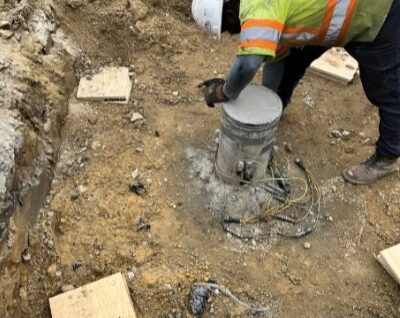
The Atlantic City International Airport utilized micropiles in the design for the new passenger loading jet-bridges. The project plan originally specified compression and tension static load tests. GRL Engineers proposed utilizing the APPLE load test system, which would allow for tension and compression capacities to be computed using CAPWAP analyses. CAPWAP results provided the soil resistance distribution along the pile length as well as the total soil resistance mobilized. Thus, both compression and tension resistance could be assessed for each pile tested. GRL Engineers used the APPLE 7 2G which has a ram weight of 2 tons for proof testing of these non-sacrificial piles. (Photos 2-3)
NYC School:
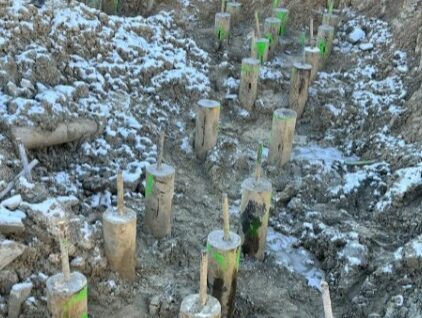
GRL Engineers utilized dynamic load testing on numerous non-sacrificial production micropiles for a New York City School. The project included 80 piles that needed to be tested. Initially, low strain integrity testing was performed to evaluate pile integrity prior to any load testing. The initial requirement was to perform static load testing on all 80 piles. However, dynamic load testing was approved for a significant portion of the project to reduce both costs and time. Testing was performed with a Junttan HHK5s hammer for testing with a follower system. (Photos 4-5)
Data Center:
Micropiles were selected for foundation support of a data center. Project specifications required approximately 50 tension proof tests to be performed. Because of the soft overburden soils, reaction piles would have been required to proceed with static tension testing. Dynamic load testing was suggested as alternative which would allow multiple piles to be tested in one day rather than one tested with static load testing. CAPWAP analysis was able to differentiate the resistance along the pile length and at the pile toe. This allowed for the bond zone capacity to be computed and compared to the required test loads and design values for the unit skin friction in the bond zone. A comparison test was performed, computing the tension capacity via dynamic load testing and tension capacity via static load test, which resulted in nearly identical results. Overall dynamic load testing proved to be significantly more cost-effective method, with savings in both cost and time being achieved. (Photo 6)

Long Island Expressway
Atlantic City Airport
NYC School
Data Center
-

- Photo 1. Long Island Expressway – Gages on Pile
-

- Photo 2. Atlantic City International Airport – Perparing Micropile
-

- Photo 3. Atlantic City International Airport – Perparing Micropile
-

- Photo 4. NYC School – Micropile with Follower
-

- Photo 5. NYC School – Micropile with Follower
-
- Photo 6. Data Center – APPLE Load Test