

Trinity River Railroad Bridge
Challenge:
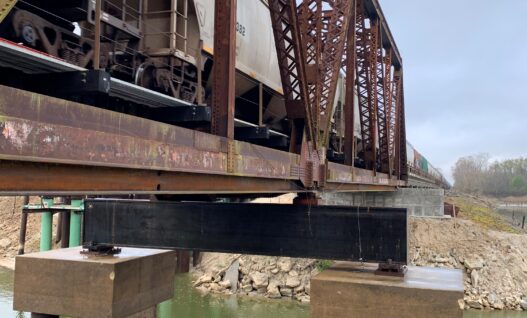
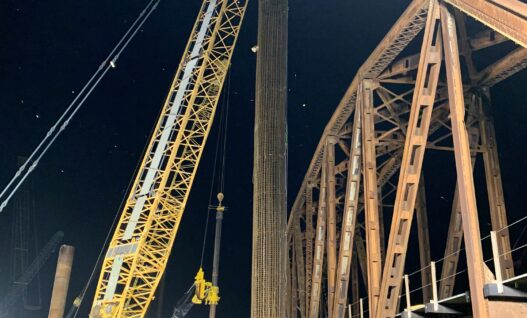
The Trinity Bridge in Liberty, Texas underwent reconstruction in 2021 to replace the aging components of the 523-foot-long railroad bridge. Originally built in 1904, the bridge connects two of the nation’s busiest ports in the cities of Beaumont and Houston. During construction, one of the drilled shafts experienced issues which reportedly caused concrete to flocculate starting at a depth of approximately 200 feet below top of original shaft. To further assess the concrete quality and load capacity, GRL Engineers performed integrity testing, and high strain dynamic testing.
Method:
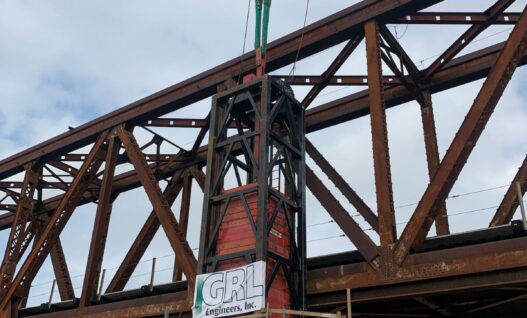
The shaft in question was drilled with a 116-inch diameter auger and utilized a reinforcing cage 108 inches in diameter. A 120-inch O.D. by 0.75-inch wall thickness permanent casing was installed in the excavation. As part of the preplanned integrity testing on the project, Thermal Wire® cables were installed along the length of the reinforcing cage, collecting temperature measurements during concrete curing and crosshole sonic logging (CSL) was conducted with ten steel access tubes (internal diameter of 2-inches) cast into the concrete during placement. Additionally, as part of the proposed remediation plan, High strain dynamic (APPLE) testing was performed using an 80-ton drop weight. The weight was dropped from varying heights up to 5.5 feet.
Results:
The data obtained during the curing process indicated that the concrete above the 200-foot-depth exhibited different characteristics than the concrete placed below the 200-foot depth. Additionally, the average peak temperature when compared to the other shafts on site were approximately 8‐15 degrees F lower. The conclusion of the TIP testing would suggest that the shaft had adequate soundness and an overall effective radius above the drill diameter, except for the upper 7 feet of the shaft as indicated in Figure 1. The CSL results did not indicate a similar soundness of the concrete.
Prior to performing the APPLE testing, the upper 7 feet of the shaft was chipped and repoured. The calculated activated static capacity from the dynamic load test was 10,416 kips and the force and velocity measurements recorded during the impact indicated no unplanned impedance change. The measured wave speed was 12,250 feet per second (fps). Results from the dynamic load test can be viewed in Figure 2.
Both the TIP and APPLE testing results suggested acceptable integrity. If there were an integrity issue as severe as CSL indicated, the stresswave induced from dynamic testing would have dissipated immediately and caused a reflected stresswave indicating a severe impedance reduction in the force‐velocity curves. It is possible that the CSL tubes became coated with a material due to the flocculated concrete that was at the concrete/slurry interface. The coating could have blocked and depleted the signal from the CSL transmitter.
Project Details
Client: AH Beck Foundation Co. Inc.
GRL Office: Texas
GRL Services
- High Strain Dynamic Testing with APPLE Systems
- Crosshole Sonic Logging
- Thermal Integrity Profiling
-
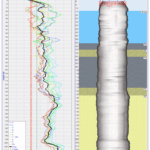
- Figure 1. Sample Thermal Integrity Profiling Results
-
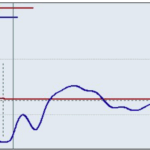
- Figure 2. Sample Dynamic Load Testing Results