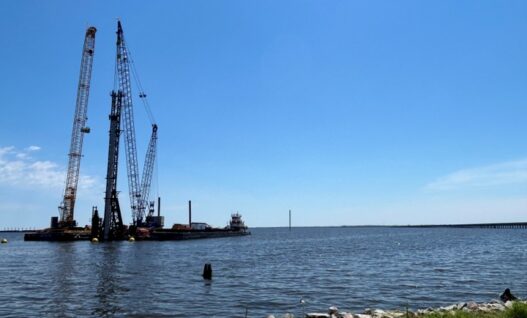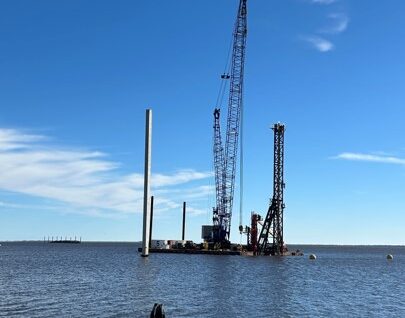

Alligator River Bridge
Challenge:
The Alligator River Bridge, built in 1960, is a swing-span bridge that allows for boat passage on the Alligator River. Due to recuring mechanical failures and bridge repairs, a new bridge was proposed and designed. The new bridge is 3.28 miles-long with a planned 100-year lifespan. The cost of the bridge is estimated to be $480 million.
The original plan called for a total of 1,045 piles ranging from 125 to 175 feet long, driven through soft silts, a dense sand layer and a stiff clay layer to a deep dense sand layer. Dynamic pile testing during driving was essential to assess the potential of pile refusal in the upper sand layers as well as what pile capacity might be achieved in this layer.
Method:
A test pile program was implemented in 2024 that included GRL Engineers performing preconstruction wave equation analyses. Eleven test piles located along the bridge alignment were performed to assess expected driving conditions and pile capacity. Only one of the eleven piles driven was able to reach the underlying deep dense sand layer. The remaining ten piles met refusal in the upper sand with mobilized capacities of 2600-3700 kips.
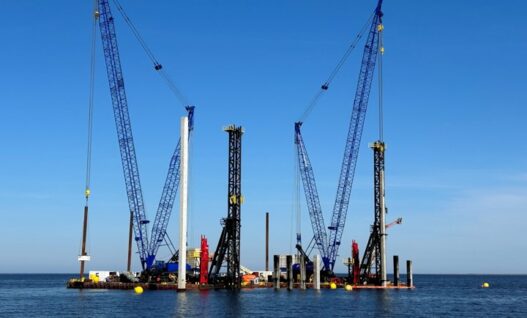
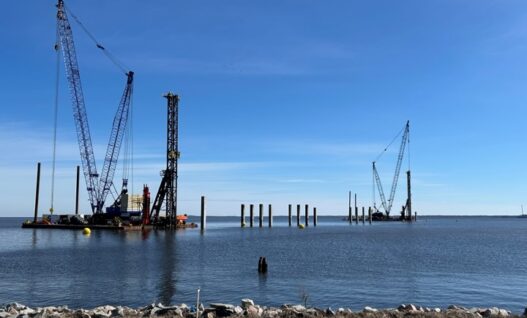
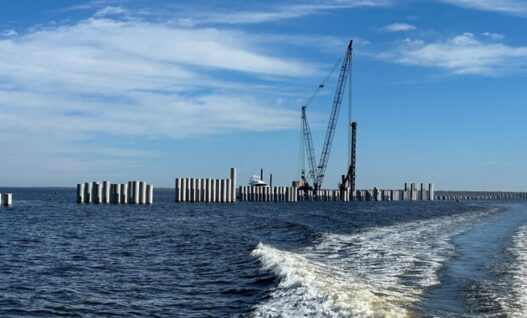
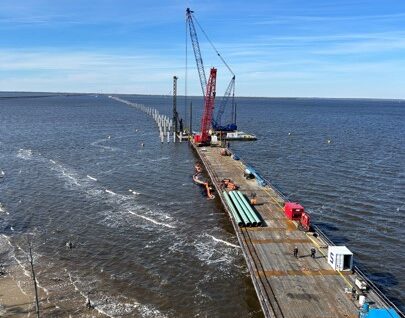
The outcome of the test pile program was to re-design the foundation. The new plan included 710 piles, which was a significant reduction (335 fewer piles). Driving began in February of 2025 with Pileco D180-32 hammers. Of the 710 piles, 48 were planned test piles, where PDA testing was used to establish driving criteria in adjacent bridge bents. The selected pile types varied from 36-inch square prestressed, concrete piles to 54-inch diameter cylinder piles.
Four different hammers were utilized with three pile driving rigs operating simultaneously for most of the pile installations.
Results:
Pile capacity requirements were achieved in the upper sand soil layer. The last driven pile was completed at the end of January, 2026, one year ahead of schedule. A total of 185 piles were tested during installation which significantly contributed to keeping the production pile installations ahead of schedule.